
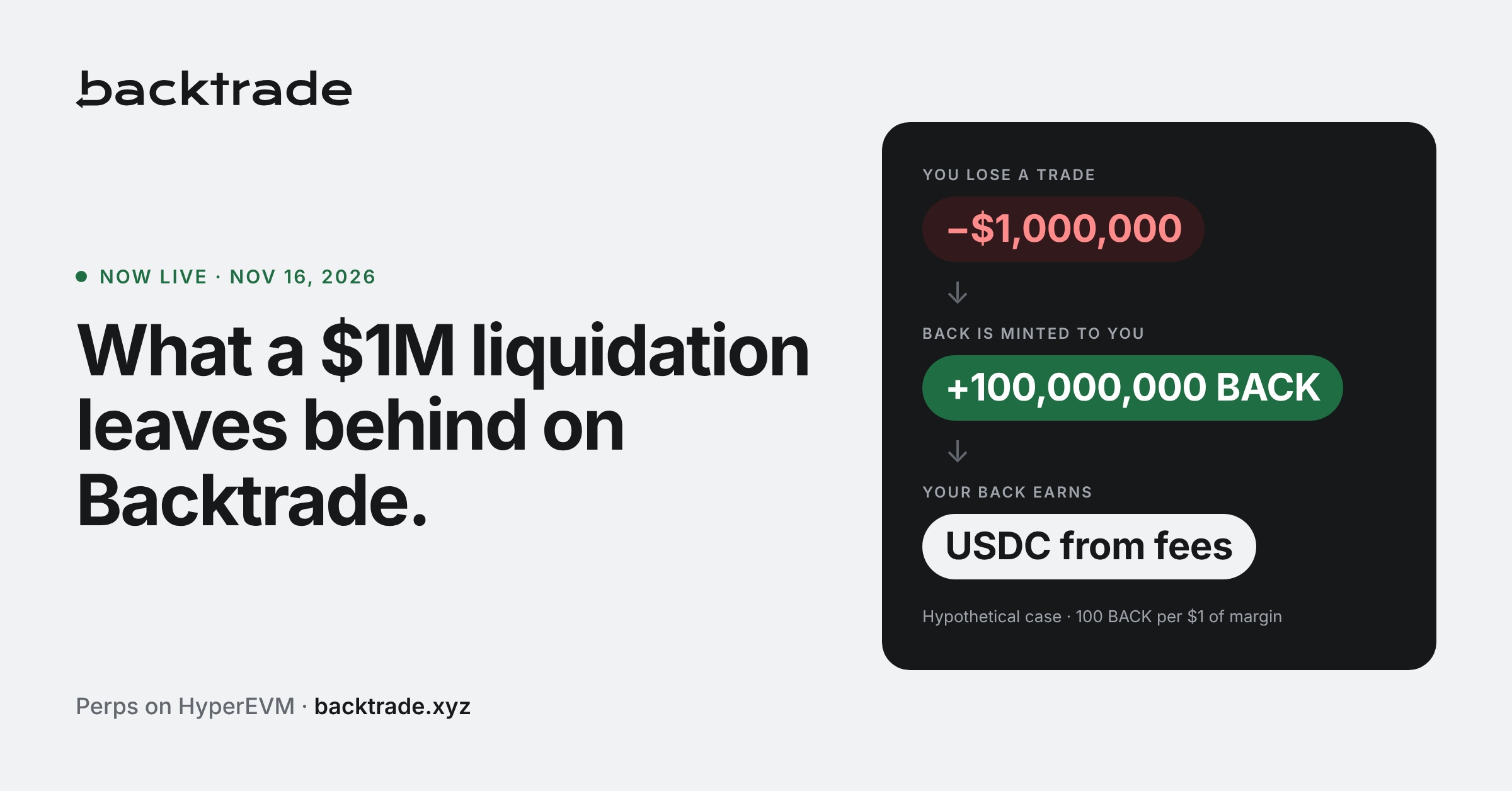
Traders lost billions in forced closures this autumn. We ran the October numbers through Backtrade’s loss-to-mint model, where every losing trade converts into a token.
November 16, 2026. Leveraged crypto traders had an expensive October. Total liquidations reached $12.5 billion for the month, Crypto Briefing reported. Long positions accounted for $9.21 billion of that and shorts for $3.29 billion.
November has run hotter. CoinGlass logged about $1.41 billion in liquidations in the 24 hours to November 13 and $1.96 billion in the 24 hours to November 15, when 313,528 traders lost positions.
On most venues, a trader’s margin leaves the account at liquidation and the trader receives nothing in return. Backtrade, a perpetuals exchange that launched today on Hyperliquid’s HyperEVM, mints a token to every trader who loses. We asked a simple question: what would October have looked like on Backtrade?
Backtrade is live. Start trading at app.backtrade.xyz with a $10 minimum margin.
Position size versus money lost
CoinGlass reports liquidations by position size, leverage included. A trader with $1,000 of margin at 10x controls a $10,000 position, and a liquidation shows up in the data as $10,000. The trader lost $1,000.
Backtrade mints BACK on the margin a trader loses: 100 BACK per dollar. To translate October’s figure, we need an assumption about average leverage. Real leverage varies from trader to trader, so the table shows three scenarios.
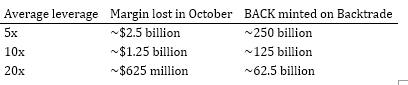
Illustration based on $12.5 billion in October liquidations. Scenarios are estimates, not Backtrade data.
Where liquidated margin goes today
Liquidated margin moves to counterparties and to insurance funds that exchanges own. BitMEX offers the clearest record. Protos reported that BitMEX built its insurance fund mainly from liquidated customer positions, and the fund peaked above 36,400 BTC during the March 2020 crash. In November 2025, BitMEX cut the fund to about 3,600 BTC without saying where the released coins went. The exchange set September 23, 2026 as its closing date and has not disclosed plans for the roughly $270 million left in the fund.
The scale across the market is larger still. CoinGlass estimated total forced liquidations at $150 billion for 2025.
Where that money would go
On Backtrade, liquidated margin flows into the house, a USDC pool that only trader losses can fill. The house pays winning traders first. BACK holders then receive two streams in USDC: half of the exchange’s win, loss and liquidation fees, and everything in the house above $500,000.
In the 10x scenario, October’s liquidated traders would have received about 125 billion BACK between them. Each token earns for seven days and then burns, and the USDC it collected stays with the trader. The model returns the surplus left after winners are paid to the traders who funded the pool.
“October’s liquidations took billions in margin that traders never saw again. On Backtrade, that money stays in the house, and after winners are paid, the surplus goes back to the traders who put it there,” said Lucas, founder of Backtrade.
The limits of the comparison
Traders on Backtrade would not trade the way October’s market did, and no exchange can promise a payout per token. Backtrade’s documentation says the project promises BACK no value. The exercise shows scale: billions in margin that, on Backtrade, would have stayed inside the exchange and paid out to the traders who lost it.
Trading on Backtrade
Backtrade fills orders at the midpoint of Hyperliquid’s best bid and offer and charges no funding. You pay no fee or gas to open. Leverage runs up to 1000x on BTC and ETH. Backtrade charges on the winning side: 2% plus a 1.2% referral fee, cut to 1% with an invite link.
The contracts have no external audit yet. If the house runs short, winning traders wait in a payout queue. At 1000x on BTC, a 0.05% move against you liquidates the position.
Open Backtrade and follow @backtrade_xyz for live data from the exchange.
About Backtrade
Backtrade is a perpetual futures exchange running in smart contracts on Hyperliquid’s HyperEVM. Traders go long or short on BTC and ETH with up to 1000x leverage, fills at the Hyperliquid mid and no funding payments. Every losing trade mints BACK, a token that earns a share of exchange fees in USDC.
Website: backtrade.xyz · Docs: docs.backtrade.xyz · X: @backtrade_xyz
Liquidation data: CoinGlass, as reported by Crypto Briefing, CoinCentral and The Crypto Times. BitMEX insurance fund: Protos. This article is for information only and is not financial advice. Leveraged trading carries a high risk of loss.


